Showing posts with label Washington Square West. Show all posts

Tuesday, June 29, 2010

Then and Now: Southeast corner of 8th and Walnut Streets, Philadelphia

c. 2000-2010

Today, the southeast corner of 8th and Walnut Streets is occupied by the base of the St. James apartment tower, completed in 2004 as one of the earliest finished projects in Center City's last residential development boom. In addition to substanially adding to the city skyline east of Broad Street, the project included a significant preservation component. The three remaining houses of York Row (one of which is pictured above) were partially preserved within the tower podium, and are now used as retail and office space. The developers also undertook a full renovation of the adjacent former Pennsylvania Savings Fund Society building facing Washington Square into a large restaurant space.

The same street corner pictured in 1917

Not much seems to be known about the one story building at the pictured street corner. However, it appears to have replaced a taller, four story commercial building that occupied the location in the early 20th century.

Photographs:
1. "HABS PA-6661-1."
Historic American Buildings Survey. American Memory. Library of Congress. 12 June 2010. http://memory.loc.gov/pnp/habshaer/pa/pa3800/pa3816/photos/213253pv.jpg.
2. Mills, Charles P. "Department of City Transit-3820-0." 1917. Philadelphia City Archives. PhillyHistory.org. Philadelphia Department of Records. 29 Jun. 2010. http://www.phillyhistory.org/PhotoArchive/MediaStream.ashx?mediaId=38467.

Monday, May 31, 2010

Then and Now: Northwest corner of 8th and Sansom Streets, Philadelphia

1917-2010

Up through the end of the First World War, this corner of Jewelers' Row conserved much of its late Victorian era appearance. Since then, through a series of alterations, the short block has lost many of its original façades and some of its former density. The building with the six-story tower on the far right of the original photo is the Times Building, built for the Times publishing company in the late 1870s and demolished roughly a century later.

Source: Philadelphia Architects and Buildings
Original photo: Mills, Charles P. "Department of City Transit-3829-0." 1917. Philadelphia City Archives. PhillyHistory.org. Philadelphia Department of Records. 5 Apr. 2010. http://www.phillyhistory.org/PhotoArchive/MediaStream.ashx?mediaId=38533.

Monday, May 24, 2010

Then and Now: 818-820 Chestnut Street, Philadelphia

1963-2010

Though not quite obvious from its current appearance, this vacant storefront on a quiet block of Chestnut Street gave birth to a true icon of 20th century American dining. In 1902 the Horn & Hardart Baking Company opened their first automat on the ground floor of the Pierson Building at 818-820 Chestnut Street. The automat, where diners purchased food and drink entirely from coin-operated machines, was the first of its kind in the United States. Horn & Hardart expanded rapidly in the decades that followed, developing a legendary presence in Philadelphia and New York before falling into obscurity at the end of the century.

The original Chestnut Street automat was enlarged and renovated during the 1930s, with design work done by architect Ralph Bowden Bencker. During the 20s and 30s, Bencker completed over thirty commissions for Horn & Hardart stores and offices, most of them in Philadelphia. After the original automat shut its doors in the late 1960s, the location operated for some time as a pharmacy. Although the original metalwork has been painted over, the exterior façade appears to be intact, save for the doorway. I've never gone through an exhaustive list of Horn & Hardart's former locations, but it's safe to say that this is certainly one of extremely few preserved storefronts of theirs left in Philadelphia.

Meet me at the automat [Smithsonian magazine]

Source: Philadelphia Architects and Buildings
Original photo: "Historic Commission-12210-48." 1963. Philadelphia City Archives. PhillyHistory.org. Philadelphia Department of Records. 4 Apr. 2010. http://www.phillyhistory.org/PhotoArchive/MediaStream.ashx?mediaId=114811.

Wednesday, April 14, 2010

Then and Now: North side of Sansom Street, west of no. 735 Sansom, Philadelphia

1931-2010

The ground-floor storefronts on this corner of Sansom Street have been completely rebuilt since the 1930s. If you look closely at the grooves of the sidewalk curb however, you will find that it remains essentially unchanged.

Original photo: Sack. "Department of City Transit-22539-0." 1931. Philadelphia City Archives. PhillyHistory.org. Philadelphia Department of Records. 8 Apr. 2010. http://www.phillyhistory.org/PhotoArchive/MediaStream.ashx?mediaId=39707

Wednesday, April 7, 2010

Then and Now: Southeast corner of 8th and Sansom Streets, Philadelphia

1917-2010

The Jewelry Trades Building was built c. 1930 on the site of four lots on the western end of the block of Sansom Street now known as Jewelers' Row. The architect, Ralph Bowden Bencker, was one of Philadelphia's more prolific early Modernist architects in the 1920s and 30s, best known for designing the Rittenhouse Plaza apartments and the Ayer on Washington Square. The Jewelry Trades Building is fairly representative of Bencker's architectural style, which can generally be characterized as a minimalist, monochrome Art Deco.

Mills, Charles P. "Department of City Transit-3822-0." 1917. Philadelphia City Archives. PhillyHistory.org. Philadelphia Department of Records. 5 Apr. 2010. http://phillyhistory.org/PhotoArchive/MediaStream.ashx?mediaId=44373.

Thursday, February 11, 2010

Then and Now: 1316-1318 Chestnut Street, Philadelphia

1955-2010

Chestnut Street, before and after the proliferation of roll-down security gates.

Bender, Charles J. and John McWhorter. "Public Works-43013-11." 1955. Philadelphia City Archives. Phillyhistory.org. Philadelphia Department of Records. 31 Jan. 2010.
http://www.phillyhistory.org/PhotoArchive/MediaStream.ashx?mediaId=89645

Wednesday, February 3, 2010

Then and Now: 1324 Chestnut Street, Philadelphia

1955-2010

Here's a shot of the former Barricini Candy shop at 1324 Chestnut Street, several doors down from the Bartons Bonbonniere shown in a recent post. Barricini's signage demonstrates that neon commercial lighting can be rather tasteful if done properly. The former Barricini and Famous Maid spaces are now occupied by the Greenhouse market and deli.

Bender, Charles J. and John McWhorter. "Public Works-43013-13." Philadelphia City Archives. PhillyHistory.org. Philadelphia Department of Records. 1 Feb. 2010. http://www.phillyhistory.org/PhotoArchive/MediaStream.ashx?mediaId=89649.

Thursday, January 28, 2010

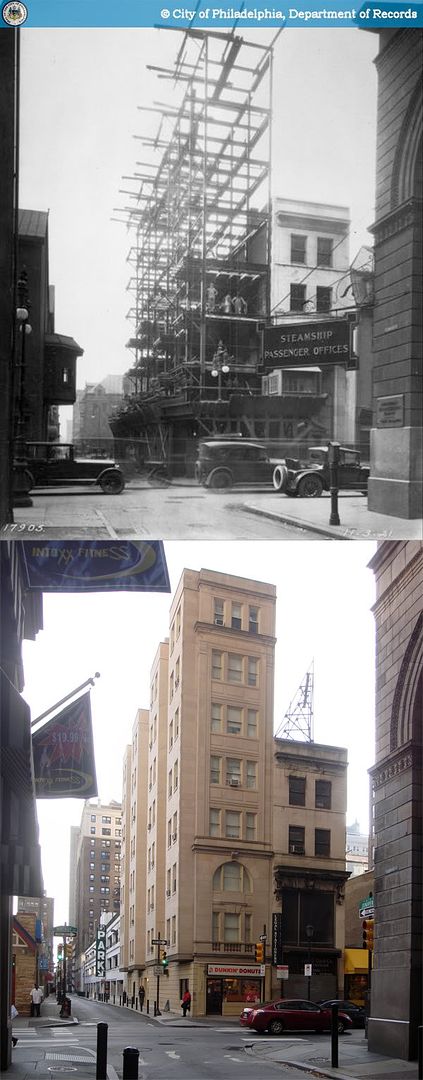
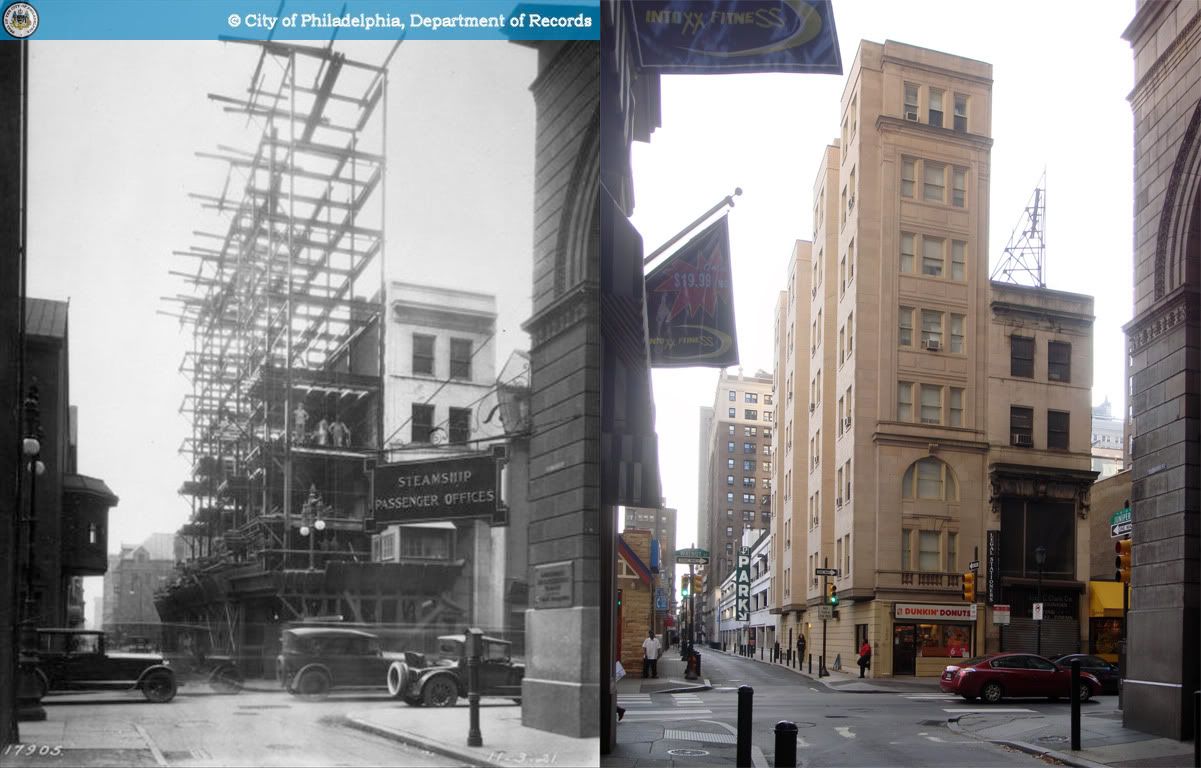
Then and Now: Southwest corner of Juniper and Walnut Streets, Philadelphia

c. 1920 - 2009

According records held by the Philadelphia Historical Commission, the Juniper Building at 1324 Walnut Street is the work of architect Arthur S. Love, completed in 1915. The original photograph however, has been dated as from 1921.

In my view, this picture is a true gem within the city's amazing photographic records. It seems surprising that such an artful photograph should be found within the Public Works collection. I find that there is something enchanting in the movement-blurred cars, the steamship office sign, the glimpse of proud workers, and the way the scaffolding seems to soar into the bright sky.

A horizontally aligned comparison may be found here.

Source: Philadelphia Architects and Buildings

Original photo: "Public Works-17905-0." 1921. Philadelphia City Archives. PhillyHistory.org. Philadelphia Department of Records. 3 Dec. 2009. http://www.phillyhistory.org/PhotoArchive/MediaStream.ashx?mediaId=102451.

Monday, January 25, 2010

Then and Now: 1316 Chestnut Street, Philadelphia

1955-2010

The building at 1316 Chestnut Street seems to date back to the early 20th century, and in 1955 was home to Bartons Bonbonniere, a candy shop. Since then, its upper stories have been lopped off, and I'm not sure what occupies the space now, if anything.

Edit: Bartons, as I have quite recently learned, was a legendary purveyor of chocolates founded in New York in 1938, widely known as a Jewish company. Bartons is also remembered for its great rivalry with Barricini's. Interestingly enough, Barricini had its own Center City store just four doors down from Bartons at 1324 Chestnut Street.

The Kosher Chocolate Wars [The Atlantic]
A Seder Different From All Other Seders [The Atlantic]

Bender, Charles J. and John McWhorter. "Public works-43013-10." 1955. Philadelphia City Archives. PhillyHistory.org. Philadelphia Department of Records. 21 Jan. 2010. http://www.phillyhistory.org/PhotoArchive/MediaStream.ashx?mediaId=89643

Monday, January 18, 2010

Then and Now: 107-115 South 11th Street, Philadelphia

1965-2009

Philadelphia has much to thank its educational and medical institutions for. In recent decades, despite the city's overall economic decline, these two sectors have achieved significant, stable growth, and now account for nearly 20 percent of the city's employment base.

Unfortunately, much of this growth came with a hidden cost - the steady erosion of the city's older streetscapes. Jefferson University Hospital proved to be a particularly bad neighbor for Washington Square West, replacing several dense, historic blocks with a series of faceless towers, thereby severing the connections between Market East and neighborhoods to its south.

Source: http://www.selectgreaterphiladelphia.com/data/employment/trends/employment.cfm
Original photo: Carollo, R. and John McWhorter. "Historic Commission-3300-12." 1965. Philadelphia City Archives. PhillyHistory.org. Philadelphia Department of Records. 14 Dec. 2009. http://www.phillyhistory.org/PhotoArchive/MediaStream.ashx?mediaId=107279

Tuesday, December 15, 2009

Then and Now: The Mercantile Library, 1021 Chestnut Street, Philadelphia

1962-2009

In 1954, ten years after joining Philadelphia's Free Library system, the Mercantile Library moved to Chestnut Street into a new building designed by local firm Martin, Stewart & Noble. The building immediately won widespread praise among the city's architectural community; Martin, Stewart & Noble were awarded 1954's Gold Medal from the Philadelphia chapter of the American Institute of Architects. Their design was acclaimed for having fulfilled the library's needs within a compact, storefront-sized space, and for its innovative adaptation of commercial design elements. The clean lines of its steel mullions, smooth glass facade, and distinctive signage make it a particularly elegant specimen of postwar Modernism in Philadelphia.

Sadly, after decades of shrinking tax revenues, the City of Philadelphia gradually became incapable of maintaining many of its facilities, including this one. The Mercantile Library shut its doors in 1989 due to a crumbling asbestos problem, and its collections were transferred to the Free Library's main branch on the Parkway. Due to daunting projected repair costs and an enormous maintenance backlog, the city ultimately chose to indefinitely close the library. Though the building was added to the Philadelphia Register of Historic Places in 1990, it has only continued to deteriorate, and substantial plant overgrowth is visible on its roof.

In 2004, the lot was transferred by the city to the Philadelphia Industrial Development Corporation, which subsequently sold it to a private developer. However, the Mercantile Library's fate remains in limbo. There do not seem to be any current plans for its redevelopment, nor any substantial push for its preservation.

Sources:
1. "Fourth Annual Endangered Properties List."
Preservation Matters. Dec. 2007. http://www.preservationalliance.com/files/news/Winter2007.pdf.
2. Wiegand, Ginny. "Library could be put on shelf."
Philadelphia Inquirer. 4 Aug. 1990.
3. Maryniak, Paul. "City's building cup runneth over." Philadelphia Daily News. 26 Feb. 1991.
Original image: Carollo, R. "Historic Commission-49797-0." 1962. Philadelphia City Archives. PhillyHistory.org. Philadelphia Department of Records. 14 Dec. 2009. http://www.phillyhistory.org/PhotoArchive/MediaStream.ashx?mediaId=108087.

Monday, November 9, 2009

Then and Now: 13th and Sansom Streets looking southwest, Philadelphia

1965-2009

Few visitors to Philadelphia today, standing at the corner of 13th and Sansom, would feel much indication of 13th Street's turbulent recent history beneath its glimmering boutiques and restaurants. Neither, ufortunately, is any of it easily apparent in the above montage.

At the time of the original photo, 13th Street between Chestnut and Locust Streets was a fur district dotted with bars and luncheonettes serving office workers from South Broad Street. By the early 90s, 13th Street had become downtown's skid row and red light district, blamed upon the continuous western movement of Philadelphia's office district. Then, it attracted substantial attention from the press for its new reputation as Center City's most blighted street, a haven for prostitution, and the new center of gay nightlife. Officials decried it as an enormous black hole between the new Convention Center and the Avenue of the Arts theater district.

Remarkably, the area's turnaround is largely attributed to one individual, shrewd New York developer Tony Goldman. In 1998, Goldman Properties began purchasing buildings in the 13th Street area, investing millions into their renovation, and aggressively marketing the district to new retailers. No doubt, that story is overly simplistic, but the changes that have occurred in the decade since then have been nothing less than momentous. Today's 13th Street is one of downtown Philadelphia's liveliest retail corridors, and the proud heart of the city's gay community.

Source: Stoiber, Julie. "'The whole street is popping' - On 13th south of Chestnut, two blocks in a red-light district are turning funky." Philadelphia Inquirer. 3 Apr. 2006. Newsbank Access World News. Haverford College Library, Haverford, PA. 12 Nov. 2009.

Original photo: Carollo, R., and John McWhorter. "Historic Commission-3299-18." 1965. Philadelphia City Archives. PhillyHistory.org. Philadelphia Department of Records. 12 Nov. 2009.