Monday, February 1, 2010

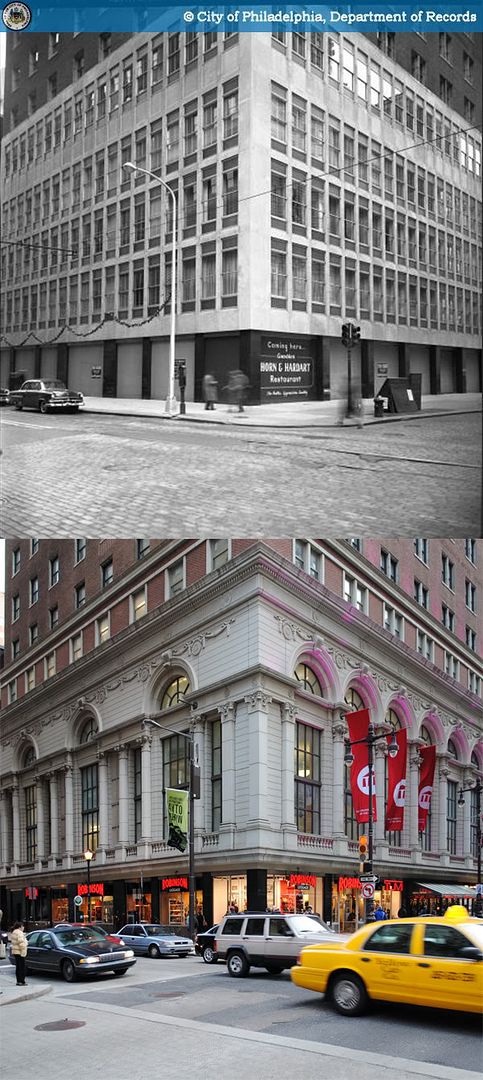
Then and Now: Southeast corner of Broad and Walnut Streets, Philadelphia

1956-2010

The 17-story tower that stands at the southeast corner of Broad and Walnut was completed in 1911 as a Ritz-Carlton Hotel, designed by Horace Trumbauer. The first five floors of the tower's façade were remodeled in a Modernist style in the mid-1950s (pictured above), and the interior was also presumably also converted into offices at that time.

211 S. Broad Street was hit hard by the office market recession of the early 90s. By 1993, all but the ground floor spaces of the building had been vacated. Fortunately, it was purchased in 1997 by the University of the Arts, which initiated a complete renovation of its interior into classroom and studio spaces. The University also undertook a faithful reproduction of the building's original façade on the second through fifth floors, using fiber-reinforced cast stone. The roof cornice however, has yet to be rebuilt, if ever. Now renamed as the Daniel J. Terra Building, its Broad Street façade is illuminated nightly by LED lights as part the Avenue of the Arts lighting initiative led by the Center City District.

A quick recap of the Terra Building renovations [Philadelphia Weekly]


Sources:
1. Adamu, Fatima. "A brief history of the illuminated buildings along the Avenue of the Arts." Center City District. http://www.centercityphila.org/pressroom/prelease121708history.php.
2. Gorenstein, Nathan. "U. of Arts to purchase Broad Street building." Philadelphia Inquirer. 10 Jun. 1997.
Original photo: Mallis, Atheniasis T. "Public Works-44385-8." 1956. Philadelphia City Archives. PhillyHistory.org. Philadelphia Department of Records. 29 Jan. 2010. http://www.phillyhistory.org/PhotoArchive/MediaStream.ashx?mediaId=64179.

Thursday, January 28, 2010

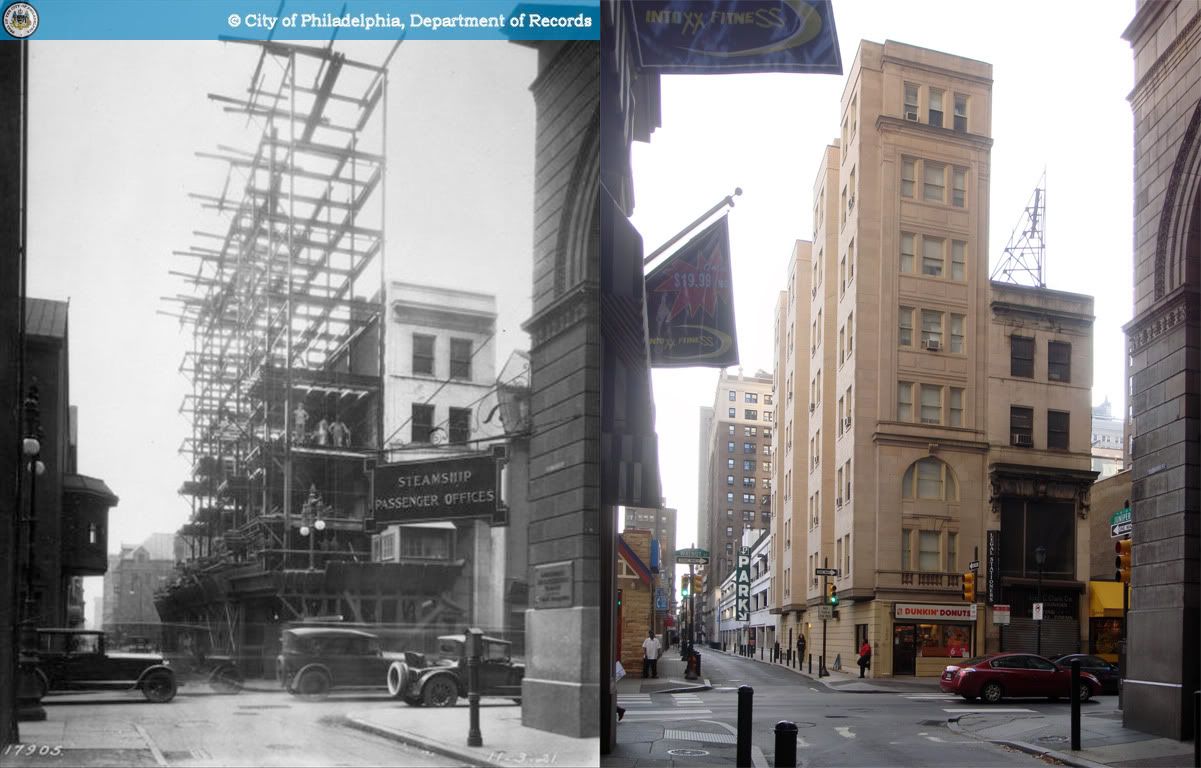
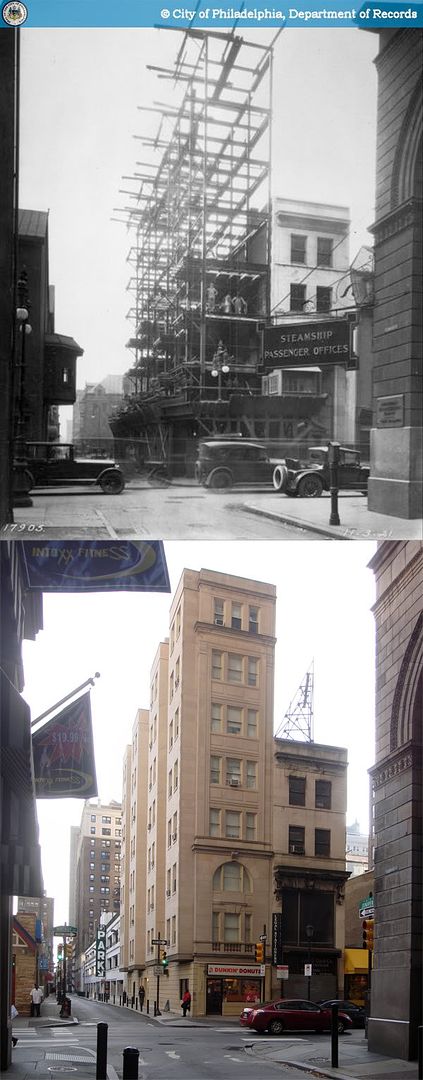
Then and Now: Southwest corner of Juniper and Walnut Streets, Philadelphia

c. 1920 - 2009

According records held by the Philadelphia Historical Commission, the Juniper Building at 1324 Walnut Street is the work of architect Arthur S. Love, completed in 1915. The original photograph however, has been dated as from 1921.

In my view, this picture is a true gem within the city's amazing photographic records. It seems surprising that such an artful photograph should be found within the Public Works collection. I find that there is something enchanting in the movement-blurred cars, the steamship office sign, the glimpse of proud workers, and the way the scaffolding seems to soar into the bright sky.

A horizontally aligned comparison may be found here.

Source: Philadelphia Architects and Buildings

Original photo: "Public Works-17905-0." 1921. Philadelphia City Archives. PhillyHistory.org. Philadelphia Department of Records. 3 Dec. 2009. http://www.phillyhistory.org/PhotoArchive/MediaStream.ashx?mediaId=102451.

Monday, January 25, 2010

Then and Now: 1316 Chestnut Street, Philadelphia

1955-2010

The building at 1316 Chestnut Street seems to date back to the early 20th century, and in 1955 was home to Bartons Bonbonniere, a candy shop. Since then, its upper stories have been lopped off, and I'm not sure what occupies the space now, if anything.

Edit: Bartons, as I have quite recently learned, was a legendary purveyor of chocolates founded in New York in 1938, widely known as a Jewish company. Bartons is also remembered for its great rivalry with Barricini's. Interestingly enough, Barricini had its own Center City store just four doors down from Bartons at 1324 Chestnut Street.

The Kosher Chocolate Wars [The Atlantic]
A Seder Different From All Other Seders [The Atlantic]

Bender, Charles J. and John McWhorter. "Public works-43013-10." 1955. Philadelphia City Archives. PhillyHistory.org. Philadelphia Department of Records. 21 Jan. 2010. http://www.phillyhistory.org/PhotoArchive/MediaStream.ashx?mediaId=89643

Saturday, January 23, 2010

Then and Now: Northwest corner of Broad and Chestnut Streets, Philadelphia

1962-2010

The neoclassical Girard Trust Bank building at the northwest corner of Broad and Chestnut Streets is one of the last and lesser-known works of Frank Furness, completed in 1908 after he had largely abandoned the uniquely exuberant style of his earlier work. Its great main hall is now the lobby of the Ritz-Carlton Philadelphia, also housed in the attached Girard Trust Company tower (1931).

The tower immediately behind the Girard Bank to the left is the Morris Building, another late and largely forgotten work of Furness. Damaged by the One Meridian Plaza fire in 1991, the 21-story structure was demolished in 2001 by developer Tim Mahoney. Alas, redevelopment plans for the site, including the most recently proposed Waldorf-Astoria hotel and residences, seem to remain in limbo.

Sources:
1. Philadelphia Architects and Buildings
2. Saffron, Inga. "The city's loss is also the city's gain." Philadelphia Inquirer. 21 Aug. 2001.
Original photo: "Historic Commission-49785-0." 1962. Philadelphia City Archives. PhillyHistory.org. Philadelphia Department of Records. 21 Jan. 2010. http://www.phillyhistory.org/PhotoArchive/MediaStream.ashx?mediaId=4135.

Thursday, January 21, 2010

Then and Now: A view down SongZhi Road, Taipei

2007-2010

Not knowing of any easily accessible repository of historic images of Taipei, I'm making do with some of my own photos from the past few years. Fortunately, the city seems to grow fast enough in a few places for these montages to be decently interesting less than 3 years later.

This is part of the city's Xinyi district viewed from one of Taipei 101's elevated walkways. The 2007 photo shows the Citibank building still under construction, as well as one of the cranes for the now soon-to-be-completed President Hotel tower.

Monday, January 18, 2010

Then and Now: 107-115 South 11th Street, Philadelphia

1965-2009

Philadelphia has much to thank its educational and medical institutions for. In recent decades, despite the city's overall economic decline, these two sectors have achieved significant, stable growth, and now account for nearly 20 percent of the city's employment base.

Unfortunately, much of this growth came with a hidden cost - the steady erosion of the city's older streetscapes. Jefferson University Hospital proved to be a particularly bad neighbor for Washington Square West, replacing several dense, historic blocks with a series of faceless towers, thereby severing the connections between Market East and neighborhoods to its south.

Source: http://www.selectgreaterphiladelphia.com/data/employment/trends/employment.cfm
Original photo: Carollo, R. and John McWhorter. "Historic Commission-3300-12." 1965. Philadelphia City Archives. PhillyHistory.org. Philadelphia Department of Records. 14 Dec. 2009. http://www.phillyhistory.org/PhotoArchive/MediaStream.ashx?mediaId=107279

Wednesday, January 13, 2010

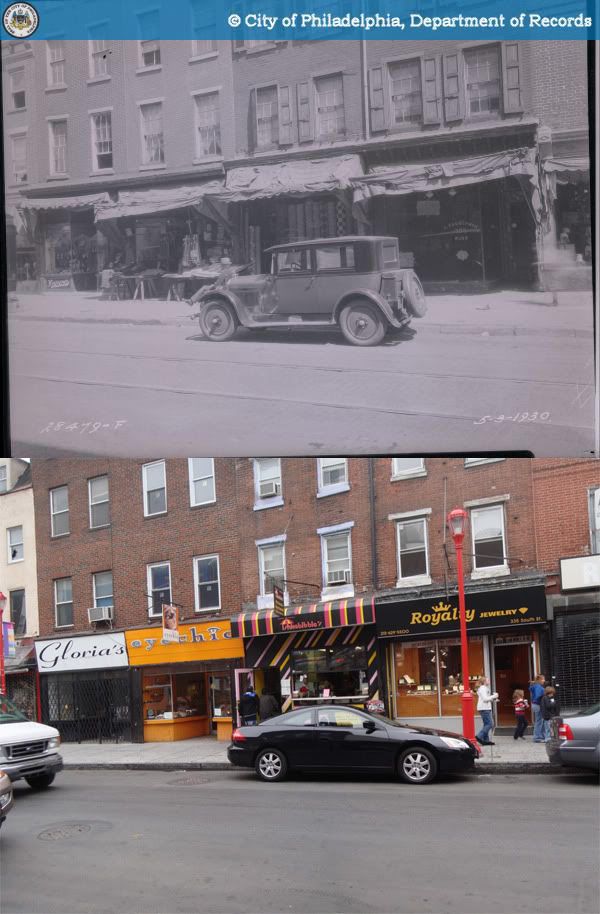
Then and Now: 335-341 South Street, Philadelphia

1930-2009

Commercial storefront awnings, once a ubiquitous presence in North American cities, have become somewhat of a rarity on South Street. Ishkabibble's Eatery, a true South Street institution at the age of 30, was the last of its neighbors to maintain an awning and a well-preserved storefront lintel/cornice. Presumably, the lintel is still there, "temporarily" hidden behind the new sign and light fixture installed several years ago.

Original image: Howell, Charles L. "Public Works-28479-0-F." 1930. Philadelphia City Archives. Phillyhistory.org. Philadelphia Department of Records. 17 Dec. 2009. http://www.phillyhistory.org/PhotoArchive/MediaStream.ashx?mediaId=27723.